Best Bank Accounts for Non-Resident US LLC Owners (2026 Guide)
Looking for the Bank Accounts for Non-Resident US LLC owners? Join us as we breakdown the top 5 options for you. Read on to learn more.

You've been filling out paperwork to form your company, searching for a dependable registered agent, and waiting on the IRS to finally mail you your Employer Identification Number (EIN). You now have a brand new US entity that is alive! It's time to start sending out invoices to clients around the world, accepting payments on Stripe, and crafting your ideal digital business from the comfort of your laptop in Bali, Medellín or Chiang Mai.
Then comes a big problem: no traditional American bank will allow you to open a business account without coming down to one of their local branches and presenting a U.S. Social Security Number (SSN).
It is a thorn that usually scares away many international founders from taking the next step, yet you do not have to fly to New York to open a checking account. Many digital banks, fintech firms, and fintech ecosystems offer complete online bank accounts for non-residents operating via US LLC entities. By properly picking the appropriate financial platform, you can avoid the cost and the inconvenience of traveling, without having to provide a copy of your Social Security Number, and manage all your money flowing in globally.
This guide is a one-stop shop that answers all your questions about the highest quality bank accounts for non-residents, fees you will incur, and an easy step-by-step roadmap that can help you get your business account on the first try.
Why Opening a US Business Bank Account is Hard for Foreigners
The very strict, decades-old regulatory framework in the United States holds traditional brick-and-mortar institutions together. Due to federal laws like the USA PATRIOT Act, banks are bound under stringent Know Your Customer (KYC) and Anti Money Laundering (AML) regulations. A high compliance risk, in the eyes of a typical U.S. bank, is a customer who is not a U.S. citizen, lacks a U.S. credit profile, and lacks a Social Security Number.
Consequently, the large commercial banks established a very simple rule: a company executive needs to come physically to the branch and get a corporate account. They would like to see your physical passport, look at your original state formation documents, and check your identity face-to-face.
Luckily, the current financial technology platforms have entirely transformed this situation. These digital platforms partner with licensed, FDIC-insured traditional banks on the back-end deposit services and apply advanced digital verification to provide accessible online bank accounts for non-residents completely remotely. They do not require a local presence and thus, are suitable for digital nomads, cross-border ecommerce sellers, and remote agency owners.
Top 5 Bank Accounts for Non-Resident US LLC Owners
Finding the most reliable bank accounts for non-residents depends on several main aspects: simple remote onboarding, low transaction costs, wide software integration, and multi-currency support. So let's get ready to take a closer look at the five leading platforms in the market.
1. Mercury: Best Overall for Startups and E-Commerce

Mercury is an exceptional choice when comparing bank accounts for non-residents who need to set up a US LLC. Mercury is a digital-only tech startup, software company, and e-commerce brand that is entirely digital and does not charge any monthly maintenance fee.
- How it Works: Mercury is not a licensed bank, it is a financial technology firm. They offer their banking services through their partner banks, Choice Financial Group and Column N.A., and your deposits are fully insured by the FDIC to the standard federal amount.
- Key features include clean digital dashboards, instant virtual debit cards, and seamless integration with essential payment processing gateways, such as Stripe, PayPal, Shopify, and Amazon. It also allows free domestic and international wire transfer of USD which can be a savior to those businesses that require sending huge sums of money.
- The Catch: Mercury compliance filters are very strict. They don't accept businesses that are dealing with high-risk such as cannabis, adult entertainment, internet gambling and some types of cryptocurrency. Additionally, your business should demonstrate that they are operating or intend to operate in the US market.
2. Wise Business: Best for Multi-Currency Management
Wise Business is an incredibly versatile option if your business regularly needs to transact with customers, freelancers and vendors across continents. Previously called TransferWise, the service focuses on helping people send and receive money internationally at the real mid-market exchange rate without hidden fees, making it a staple among bank accounts for non-residents.
- How it Works: Wise is a registered Money Services Business (MSB), not a bank. When you open a US business profile, Wise provides you with local routing numbers, account numbers and SWIFT codes that enable your electronic account to feel and function just like a normal domestic bank account for your clients.
- Key Features: You can hold, manage, and convert more than 40 different currencies inside a single digital profile. Wise always converts currencies at the mid-market rate, whether you're converting your USD income into Euros or British Pounds for remote staff pay, and they charge a small, transparent percentage fee, which is much lower than traditional commercial bank markups.
- The Catch: Wise Business doesn't set up for free. For the US-registered companies, there is a one-time setup fee which is around $31 to get local account details. Furthermore, as an MSB and not a bank, it does not provide overdraft facilities, business credit lines, or extensive treasury investment features.
3. Relay Financial: Best for Team Expense Controls
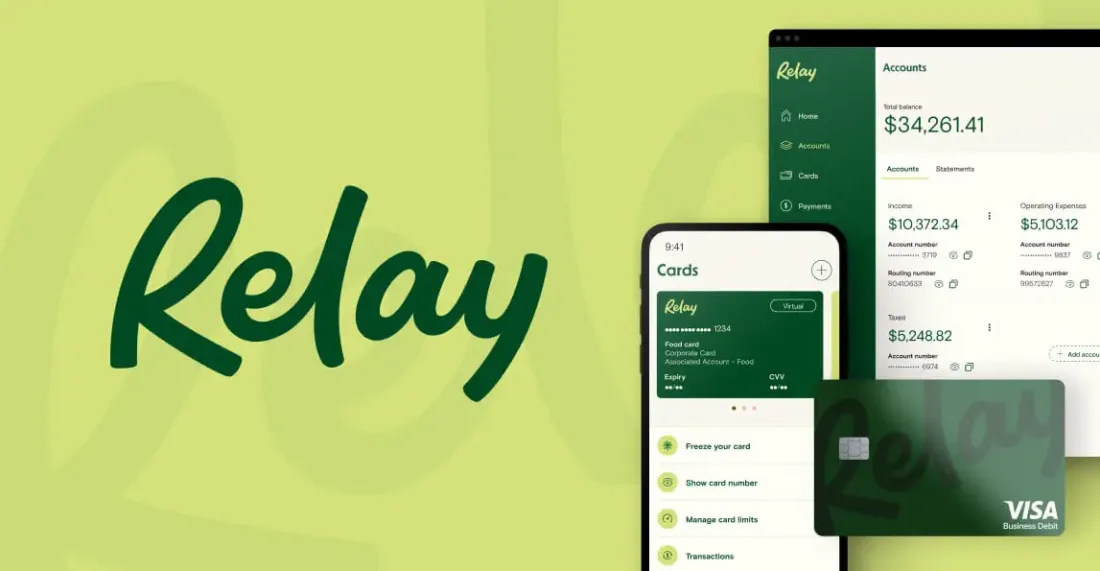
Relay Financial is an innovative digital platform dedicated to providing small business owners, agencies, and e-commerce businesses with transparent, streamlined financial services, making it a top contender among digital bank accounts for non-residents.
- How It Works: Just like Mercury, Relay is a fintech company that works with Thread Bank to supply secure as well as FDIC-insured business examining accounts.
- Key Features: Relay lets you open up to 20 checking accounts under one business name. If you have a specialized budgeting system like Profit First, then this is a dream come true for founders, as it will help you to set aside money for taxes, payroll, operational expenses, and profit margins. With up to 50 physical or virtual Mastercard debit cards, you can also highly customize spending limits for remote team members.
- The Catch: The basic account is free, but to get automated accounting workflows, batch wire payments and deep integrations, you'll need to upgrade to Relay Pro for $30 per month.
4. Payoneer: Best for Global Marketplace Sellers
When evaluating digital solutions and bank accounts for non-residents, Payoneer stands out as a well-known financial hub where you can receive payouts from around the world. Ideal for digital nomads who are marketplace sellers on Amazon FBA, eBay, or freelancing sites like Upwork and Fiverr.
- How it Works: Payoneer is like an international payment network, offering localized receiving accounts in major global currencies, such as USD, EUR, GBP, CAD and AUD.
- Main Functions: It connects directly with hundreds of worldwide freelance and e-commerce platforms, making mass payouts exceptionally effective. Payoneer is good for international freelancers and supply chain partners because it allows them to send funds from one Payoneer account to another without any charges.
- The Catch: If you compare the fee structure of Payoneer with Mercury or Wise, you will find that Payoneer is more aggressive. When receiving payments through ACH in the US, you will typically be charged a 1% fee, and transferring your balance to your home country bank account will incur high conversion and transfer fees. They also charge a yearly inactivity fee of $29.95 when your account does not have any transactional volume for 12 months in a row.
5. Traditional US Banks (Bank of America / Chase): Best for Scale
While traditional options serve as premier bank accounts for non-residents looking to scale, they do require an in-person footprint. If your long-term business plan involves raising venture capital, securing major corporate credit lines, or processing massive physical product shipments, a traditional tier-one US commercial bank remains an unmatched asset.
- How it Works: You select a traditional institution like Bank of America, Chase, or Citibank. You gather your paperwork, schedule an appointment, and physically travel to the United States to complete your application with a business banker.
- Key Features: You get access to the full suite of American corporate finance tools, high-limit business credit cards, commercial loans, and dedicated relationship managers. You also eliminate the risk of automated fintech compliance algorithms freezing your account due to sudden shifts in international transactional patterns.
- The Catch: This option requires physical travel, hotel expenses, and significant time commitments. These accounts also enforce strict monthly maintenance fees ranging from $15 to $95 unless you maintain hefty minimum daily balances inside the account.
Direct Feature Comparison
The absolute best bank accounts for non-residents will depend on a number of factors, such as your business structure, how many transactions you need each month, and your spending habits. This structural breakdown highlights exactly how the leading options compare across key transactional variables.
| Financial Platform | Remote Setup? | Monthly Account Fee | Minimum Opening Deposit | International USD Wire Fee |
|---|---|---|---|---|
| Mercury | Yes (100% Digital) | $0 | $0 | Free |
| Wise Business | Yes (100% Digital) | $0 (One-time $31 setup) | $0 | Small percentage-based fee |
| Relay Financial | Yes (100% Digital) | $0 (Basic plan) | $0 | $10 per wire |
| Payoneer | Yes (100% Digital) | $0 ($29.95/year if inactive) | $0 | 2% of total transaction value |
| Chase Bank | No (Requires branch visit) | $15 – $95 (Waivable) | Varies by branch | $40 – $50 per wire |
Does Your LLC's State Matter for Banking?
A point most guides fail to mention: the state where you formed your LLC can have an impact on your ability to secure bank accounts for non-residents.
The two most popular choices for non-residents are Wyoming and Delaware, and both are acceptable for banking purposes. Neither state requires you to be physically located there, and both are easy to recognize by compliance staff at Mercury, Wise, and Lili…which is a good thing. Reviewers will keep seeing these providers over and over again and they will know what legitimate paperwork looks like.
The problem is when people select an odd state, with odd formation rules, and arrive at a bank with odd documentation that the bank has never seen. That's the perfect mix of "unfamiliar paperwork" and "non-resident applicant" that raises red flags. Go with a proven state, and maintain an up-to-date Certificate of Good Standing, and eliminate one additional variable that could delay your application.
A Note for Digital Nomads Specifically
If you're running this LLC while moving between countries every few months, there's an extra wrinkle worth flagging. Certain platforms powering bank accounts for non-residents query you on your country of residence upon onboarding, and some will periodically re-verify that data.
Update your address on file if you move somewhere for a longer period of time and maintain a simple record of where you were living and when. It seems like double talk until you're questioned about a wire transfer from a different country than the one you've registered on your account during the compliance review. Five minutes of explanation and date and you're better off than being frozen up with an account until you can figure out where you lived the previous spring.
It also ensures that your business activity is aligned with your public presence. Even if it's legal, it is a red flag if your LLC's website states that you are an e-commerce business but your transactions resemble consulting contracts. Compliance teams are not trying to catch you; they are simply identifying patterns, and if your pattern is different, it will be flagged and reviewed, no matter whether you did it on purpose or by accident.
Required Documentation for Non-Resident Founders
To successfully open secure bank accounts for non-residents, you need to gather a specific set of corporate and personal identity documents. These items, neatly organized and kept as a high-resolution, clean PDF scan, will greatly expedite your approval process.
1. State-Approved Articles of Organization
This is the official founding document approved by the US state where you registered your company (most commonly Wyoming, Delaware, or New Mexico). It proves that your limited liability company is a legitimate, active legal entity.
2. CP575 or 147C Letter (Official IRS EIN Verification)
Your Employer Identification Number is your company's federal tax ID number. Digital banking systems will pull this number to run automated checks against the IRS database. You must upload the official confirmation letter sent by the IRS, which is typically a Form CP575 or a Form 147C.
3. Valid, Unexpired International Passport
As you don't have an American driver's license and SSN, your first tool for identifying yourself is a valid international passport. Make sure the photograph is crisp and clear and that the document is valid for at least six months before it expires.
4. Business Address Proof
All online platforms will ask you to provide a business address. While fintech platforms will happily accept an international residential address as your primary place of business, they strictly reject standard commercial registered agent addresses, virtual P.O. boxes, or generic UPS Store addresses for compliance mapping.
5. Proof of Active Business Operations
Fintech compliance teams are interested in knowing how your business makes money. Be ready to provide a live link to an established professional website, portfolio pages, LinkedIn business profiles, or active store links such as Amazon or Shopify.
Step-by-Step Guide to Opening Your Account Online
While securing online bank accounts for non-residents may seem straightforward, one minor error or mismatch in your documents can lead to a hasty denial from automated systems. Run this sequence of operations to guarantee a trouble-free application stream.
1. Organize and Double-Check Your Corporate Paperwork (Estimated time: 15 minutes)
Compare your state formation documents and IRS EIN letter. Check every single character. Your company's legal name, spelling of your address and tax ID digits should be exactly the same in all documents. A simple misspelling on one form (e.g. "Global Traders LLC") and another (e.g. "Global Traders, LLC") can cause an automated compliance red flag.
2. Select the Ideal Financial Platform for Your Business (Estimated time: 10 minutes)
Evaluate your basic operating requirements. For software-as-a-service (SaaS) operators or agencies that need a totally free USD wire transfer, head to Mercury. Choose Wise Business if you're a digital nomad with a range of income in British Pounds, Euros, and Australian Dollars.
3. Submit Your Complete Personal and Corporate Data (Estimated time: 20 minutes)
Go to the digital application portal. Use your official business information as listed on IRS documents. If the platform asks for your personal identification data, enter the information about your foreign country and upload the high-quality, colored scans of your foreign passport.
4. Detail Your Business Operations with Total Transparency (Estimated time: 10 minutes)
Write a simple, layman's explanation of your business. Avoid giving vague statements such as "I do international consulting". Rather, include more specific details such as "I'm a freelance UI/UX designer helping North American software companies with their digital product layouts." Add live links to your working site or professional portfolio to support your statements.
5. Complete the Identity Verification and Wait for Approval (Estimated time: 1-5 business days)
Please follow the biometric identity prompts on the screen. Most modern platforms will show you a secured QR code that you will need to take a real-time selfie with your mobile smartphone to verify that you are the same person as in the passport photo. After submitting, check your email for approval in the following business days or for further compliance questions.
Hidden Fees and Pitfalls to Avoid
When researching digital platforms and bank accounts for non-residents, beware of hidden fees. Many digital platforms boast themselves as "free"; however, financial establishments have to make cash somehow. Hidden transaction costs can cost you hundreds of dollars a month if you aren't reading the fine print.
1. Foreign Exchange (FX) Markups
One platform may claim that they have no monthly charges, but once you exchange your USD corporate account to your local home currency, they will charge you an aggressive 1.5% to 3% markup. If a business makes $20,000 per month, then a hidden 2% FX mark-up will cost them $400 each month. Always check for platforms such as Wise, which offer transparent and verifiable mid-market exchange rates.
2. Inactivity Assessments
Some international payment providers actually charge your company if you don't use your account enough. As mentioned above, platforms such as Payoneer charge a fixed inactivity fee if there is not a certain volume of transactions in your digital wallets in 12 months.
3. Intermediate Wire Expenses
While some platforms, such as Mercury, offer free international transfers for USD, the global banking system operates on a series of interconnected links called intermediary banks that are used to move funds across borders. These intermediary institutions often take a cut from the total wire value (generally ranging from $15 to $35) while funds are in transit.
How to Maximize Your Approval Odds
Fintech platforms offering bank accounts for non-residents turn down thousands of international business applications on a monthly basis. Their compliance algorithms have a strict binary logic, as their onboarding is automated. Your business's best chance for immediate approval is to follow these basic principles:
- Avoid the Under-Construction Pages: Do not apply for an application on a web domain with a "Coming Soon" splash screen or with a generic template. If your website is not fully functional, compliance officers will assume your business is a shell and reject your profile. Make sure your website includes an "About Us" page and a specific listing of services.
- Declare All Major Shareholders: If business partners are involved in co-founding your LLC, be 100% transparent about the ownership. Transparency rules under federal law require that platforms collect personal identity documents and passport scans of anyone who holds 25% or more stake in the company. When trying to hide a big foreign shareholder, a manual compliance block will be set up.
- Be Patient with the IRS Database: If you have just received your EIN by phone or from an expedited filing service yesterday, don't rush to apply for a digital bank account the next afternoon. The IRS often takes from 7 to 14 business days for a brand-new tax identification number to be uploaded into its permanent federal verification networks. Early applications will result in automated background checks by the bank stating that your EIN does not exist.
Common Mistakes That Get Applications Rejected
You would be surprised to know that a lot of rejections are not because of your country of residence. That boils down to tiny, correctable mistakes.
- Mismatched addresses. If the address provided on the LLC formation documents differs from what you provided on the banks' application, that alone could cause the banks to manually review your application or simply reject it. Be sure to line up all documents.
- Vague business descriptions. Mentioning "consulting" or "online business" alone is a compliance red flag. Make it clear: what is being sold, who is buying it, and where the money is going.
- Applying before your EIN arrives. All of the providers listed here will ask for your EIN confirmation letter before they even look at your application. Don't waste a submission attempt without it in hand.
- Using a registered agent address as your business address. Some providers will not accept registered agent addresses, as it does not indicate a real operating presence. Before applying, please review each provider's specific requirements.
- Ignoring the country restriction list. Some countries are off-limits due to either the U.S. sanctions or internal compliance policies, regardless of how pristine your paper is. Don't waste weeks on an application that isn't going to be approved.
The Bottom Line
The landscape of bank accounts for non-residents in 2026 makes Mercury and Wise Business the clear winners for most corporate setups. The winning combination for most non-resident US LLC owners in 2026 is creating your LLC, obtaining your EIN, and opening a Mercury account as the base location of your operations. If your business has multiple currencies, or if Mercury is not available in your country, add Wise Business to the mix.
Skip the traditional banks unless you genuinely need in-person branch access or a long-term lending relationship down the road. The fintech platforms designed for global founders will help you get moving faster, with fewer headaches, and without a plane ticket.
After opening your account, don't let paperwork fall by the wayside. Fill out Form 5472, file your BOI report, and keep your business and personal money lanes separate. This is what really makes your LLC (and the bank account associated with it) live and work for you.
If you a non-resident US LLC owner or a digital nomad looking to explore what its like living and growing(financially) in the US, then our blog is a must-read for you.