
You’re at Dubai International, your phone’s at 4%, your checked bag is in the wrong carousel, and the hotel Wi-Fi is throttled to near-zero, and you’ve got a three-hour layover. Does that sound familiar? The wrong gear doesn’t just inconvenience you; it costs real time, real money, and mental energy you can’t afford to spend at the start of a trip. Therefore, it is important to keep the best travel gadgets with you while travelling.
The travel technology space in 2026 is the most crowded it’s ever been. Every brand promises the lightest, smartest, longest-lasting solution. Most are, in fact, telling the truth about one of those 3 claims. Another challenge is finding gear that delivers on all three without requiring a second bag to hold the accessories.
This guide cuts through the noise with honest, hands-on testing across six categories – power, connectivity, security, audio, photography and comfort – tested on real trips across three continents. Here’s what really stood the test when the trip got difficult.
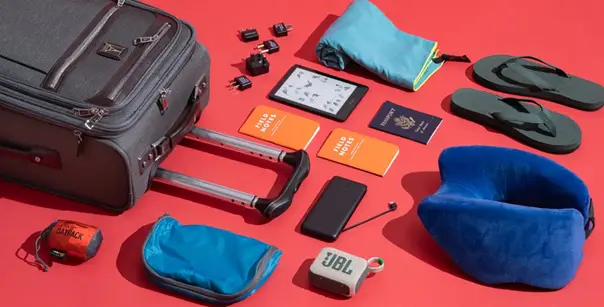
How We Tested and Ranked The Best Travel Gadgets
We tested each product over six weeks on two kinds of trips: a long-haul flight over eight hours and a whirlwind multi-city trip where we had to repack daily. No lab conditions — gear was tested the way travelers really use it. That’s what we measured.
Build Quality — We tested each product’s performance after six weeks of actual travel, carelessly stuffed in bags. If it cracked, or scratched, or stopped working reliably in that window, it didn’t make the list.
Portability — We weighed each product and measured its packed size. Anything that added meaningful bulk without a corresponding performance benefit was scored down. Travel gear has got to earn its space.
Real-World Performance — We tested each product in real-world travel conditions: hot, humid 35 °C weather, sketchy hotel Wi-Fi, airport security trays, and cargo hold temperatures. We looked at spec sheet claims versus our on-the-ground experiences.
Price-to-Value — We compared each product with its closest competitor at a comparable price. If a product costs twice as much, it should be a meaningfully better experience, not just marginally better specs on paper.
Airline & Compatibility Compliance – All products verified against 2026 IATA carry-on battery regulations, tested for universal voltage compatibility across 100-240V markets, and confirmed for cross-platform compatibility across iOS and Android ecosystems.
Power & Charging: Keeping Your Devices Alive
A dead battery is not the same as a trip killer. Whether you’re navigating an unfamiliar metro system, checking into a hotel after a midnight delay, or jumping on a video call from a co-working café with four outlets and twenty laptops, power is the foundation on which everything else rests. Four products are worth packing.
1. Anker 733 Power Bank
The Anker 733 (10,000 mAh, 65W) also functions as a wall charger—fold out the built-in prongs, plug it into any outlet, and it will charge itself and your devices simultaneously. No separate adapter required. It’s a 198g pocket-sized powerbank, with a 65W USB-C output that will charge a MacBook Air in around 90 minutes. The only limitation is capacity: 10,000 mAh provides about 2 full smartphone charges. Note that some airlines classify their built-in prongs as banned, so double-check with your airline before packing.
2. Baseus Adaman 2 Pro (20,000mAh)
For longer trips or multiple devices, the Baseus Adaman 2 Pro is the pick. Provides 65W PD output, 20W Qi2 wireless charging, and an LED display of battery percentage. It’s a bit heavier at 445g than the Anker 733, but that weight gets you three full days of multi-device use without hitting a wall outlet.
3. Anker Prime 100W 3-Port GaN Charger
GaN chargers run cooler and are smaller than the traditional silicon chargers. Universal voltage is standard. Anker Prime 100W is the benchmark: two USB-C ports, one USB-A, 100W output, and a body the size of a dice cube — charges a MacBook Pro, iPhone 16, and AirPods together without throttling. The Ugreen Nexode 65W is the bargain basement option at 40% less, sacrificing one port and 35 watts, but covering most use cases.
4. Bigblue 28W Foldable Solar Charger:
Solar chargers fit one scenario: outdoor trips of three days or more off the grid. The Bigblue 28W takes about 3 hours to charge a phone fully in clear sunlight, but cloud cover and angle will affect the actual output. Useful for overlanders and trekkers. Skip it if you’re traveling in the city.
Product | Capacity / Output | Weight | Carry-On Compliant | Best For |
Anker 733 | 10,000 mAh / 65W | 198g | Yes | Everyday travellers |
Baseus Adaman 2 Pro | 20,000 mAh / 65W + Qi2 | 445g | Yes (under 100Wh) | Long trips/groups |
Anker Prime 100W GaN | 100W / 3 ports | 163g | Yes | Multi-device charging |
Bigblue 28W Solar | 28W panel | 380g | Yes | Off-grid / trekking |
Our pick: Anker 733 for most travellers, paired with the Anker Prime 100W GaN for anyone carrying more than two devices.
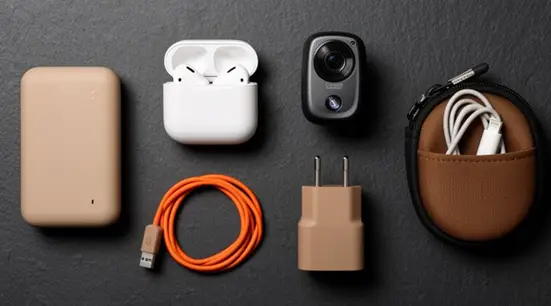
Connectivity: Staying Online Anywhere In The World
In 2026, internet access isn’t a travel luxury; it’s infrastructure. Connectivity handled before departure solves missed flight updates, navigation failures, and unreachable accommodations. The two dominant technologies are portable Wi-Fi routers and eSIM cards. Here are three products to check out below.
1. Airalo eSIM
Airalo is the lightest, fastest connectivity solution for the solo traveller. You purchase and download a local data plan straight to your phone before boarding the plane – no physical SIM card, no roaming fees, no waiting in line at a kiosk at the airport. Airalo will be available in over 200 countries by 2026, with regional plans starting at $4.50 for 1GB, and going up to 20GB for longer visits. The moment your phone connects to a local tower, your plan begins. Airalo removes all the friction points of international connectivity for anyone who needs to connect a phone and maybe a hotspot tablet.
2. GL.iNet Beryl AX (GL-MT3000)
The GL.iNet Beryl AX is the best portable Wi-Fi router for travellers who need to connect multiple devices at once. It supports Wi-Fi 6, can handle 48 simultaneous connections, runs the open-source OpenWrt firmware, and has a built-in VPN client that encrypts all devices on your network without per-device configuration. That is the pick if you’re travelling with a partner or family, or running a laptop, tablet, and phone at the same time, and don’t want to drain your phone’s battery on hotspot duty. It supports any local SIM or eSIM so that you can keep data costs down compared to routers with proprietary plans.
3. Skyroam Solis Lite
The zero-configuration alternative is the Skyroam Solis Lite (updated 2026). An app manages all the built-in global data plans, so there are no SIM cards, no plan shopping, and no router settings. You switch it on, and it hooks up. It supports up to 10 devices and is based on the 4G LTE network across its global coverage network. The downside is cost: Skyroam’s rates per gigabyte are significantly higher than buying a local eSIM, and the hardware itself comes with a premium. It’s just the right choice for those travellers who really want one thing that does it all with no setup.
Product | Standard | Max Devices | Data Plan | Best For |
Airalo eSIM | 4G / 5G | 1 device | App-purchased | Solo travellers |
GL.iNet Beryl AX | Wi-Fi 6 | Up to 48 | Bring your own SIM | Groups, remote workers |
Skyroam Solis Lite | 4G LTE | Up to 10 | Built-in (paid per GB) | Simple plug-and-play |
Our pick: Airalo eSIM for solo travellers. GL.iNet Beryl AX for families, digital nomads, and anyone running multiple devices.
Security & Tracking: Protect Your Luggage And Data
Luggage delays, theft, and payment skimming are among the most disruptive issues that occur on trips. The right gear won’t eliminate these risks, but it will drastically reduce them and give you actionable information when things go wrong. These are the 5 products to carry.
1. Apple AirTag (2nd Gen, 2026)
Best tracker for iPhone users: AirTag Gen 2. It increases the range of the Find My network, provides a louder speaker for finding nearby devices, and maintains IP67 water resistance. The big advantage is network density – any iPhone in the vicinity quietly pings your tracker location. If your bag winds up at a depot, Apple’s network regularly locates it within a matter of hours. Battery life is about one year on a CR2032 cell.
2. Samsung Galaxy SmartTag 2
SmartTag 2 is the AirTag alternative for Samsung Android users. Compatible Galaxy devices use UWB precision finding to help you find your bag within centimetres. IP67 waterproofing and a 6-month battery make for a solid tracker that plays well with SmartThings.
3. Tile Pro (2026 Edition)
The Tile Pro is the best cross-platform tracker for iOS and Android households. Its long-standing Life360 partnership has significantly expanded its crowd-sourced detection network, and its 90dB speaker is the loudest on any consumer tracker — really useful when your bag is physically nearby but buried beneath airport seating. Battery life is around a year on a CR2032 cell, and IPX5 water resistance covers most real-world scenarios.
4. Bellroy RFID-Blocking Note Sleeve
RFID skimming is silent, contactless, and preventable. The Bellroy Note Sleeve is a slim leather design that looks like a regular wallet but blocks all card frequencies. The Travelambo Front Pocket Wallet gives you the same protection in nylon for a fraction of the price.
5. Clatent TSA 4-Digit Lock
The Clatent 4-Digit TSA Lock is easy to reset, features a steel cable for double zippers, and withstands daily use without issue. Lock: The Forge TSA Lock with Alarm is a lock that will sound an alarm if it is opened improperly – useful if you are staying in a hostel. Both are TSA master key compatible.
Product | Platform | Battery Life | Detection Range | IP Rating |
Apple AirTag Gen 2 | iOS (Find My) | ~1 year (CR2032) | UWB + Bluetooth | IP67 |
Samsung SmartTag 2 | Android / Galaxy | ~6 months | UWB + Bluetooth | IP67 |
Tile Pro 2026 | iOS + Android | ~1 year (CR2032) | ~120m Bluetooth | IPX5 |
Our pick: Apple AirTag Gen 2 for iPhone households. Tile Pro 2026 for Android users or mixed-platform families.

Audio & Noise Cancellation: Survive Long-Haul Flights
Fourteen hours of economy is something you survive, or something you deal with. The key to this is a good pair of ANC headphones. That is one area where more spending pays off in visible, tangible dividends—the difference between price tiers is real and immediately obvious. And here are the three candidates for 2026.
1. Sony WH-1000XM6
For travellers, the XM6 is the best noise-cancelling headphone at any price, and it arrives in early 2026. Eight microphones power a dual-processor ANC system, with Sony’s new Adaptive Sound Optimiser instantly adjusting cancellation in real time to ambient conditions — plane cabin, train carriage, busy café — with no manual input. The sound quality is excellent across genres, the 32-hour battery easily covers even the longest routes, and multipoint Bluetooth connects a phone and a laptop simultaneously without manual switching. It’s an investment of around $380, but a quick payback over a handful of long-haul routes.
2. Bose QuietComfort Ultra
If you’re a traveller who prioritises lasting physical comfort over pure ANC performance, the Bose QC Ultra is the one to pick. The ear cushion design and clamping force distribution are still the most comfortable of any over-ear headphones for all-day wear. If you’re wearing headphones for eight hours or more in one sitting, that margin matters more than marginal ANC differences. Sound quality and noise cancellation are both great, with a slight edge to Sony on the latter. The only real limitation on ultra-long-haul routes is the 24-hour battery.
3. Soundcore Space Q45
For those who can’t justify the $300-plus price tags on headphones, Anker’s Soundcore Space Q45 is the value answer in 2026. The hybrid ANC cancels a significant percentage of engine and cabin noise, multipoint Bluetooth is included, and the 50-hour battery outlasts every other competitor in its price bracket. It’s not quite the Sony or Bose experience — the ceiling for ANC is lower, the soundstage narrower — but the difference is difficult to quantify without a direct, careful side-by-side comparison. And for infrequent long-haul travellers who fly a handful of times a year, it’s the right call, all the way.
Product | ANC Performance | Battery | Weight | Price (approx.) |
Sony WH-1000XM6 | Excellent | 32 hrs | 254g | ~$380 |
Bose QC Ultra | Very good | 24 hrs | 240g | ~$299 |
Soundcore Space Q45 | Good | 50 hrs | 253g | ~$80 |
Our pick by tier: Soundcore Space Q45 under $100. Bose QC Ultra under $300. Sony WH-1000XM6 for those who want the best available.
Photography & Videography: Capture Every Destination
Smartphone cameras have come a long way, but they still lack in-motion stabilisation, optical zoom, and low-light video. For the travelling image-maker who cares about the footage they bring home, a dedicated compact camera is still the better tool. And here are the four products that made the cut:
1. GoPro Hero 13 Black
The Hero 13 can shoot up to 5.3K at 60fps, adds a magnetic lens system that lets you swap between standard, ultra-wide, and macro lenses in seconds without tools, and extends battery life by 15% over the Hero 12 with improved power management. HyperSmooth 7.0 is the smoothest stabilisation of any action camera. It holds up through running, cycling, and boat footage without the artificial, over-corrected look that cheaper systems produce. The GoPro accessory ecosystem is second to none, with more mounts, cases, drones, and third-party rigs for GoPro than any other action camera brand, and that matters when you need a certain rig for a certain shoot.
2. DJI Osmo Action 5 Pro
The Osmo Action 5 Pro is a better fit for travellers who shoot mostly indoors, in low light, or for vlogging. Its 1/1.3” sensor is larger than GoPro’s, and produces significantly cleaner footage in markets, restaurants, and low-light heritage sites. Its 4K/120fps slow-motion feature blows the Hero 13 out of the water, and the front-facing touchscreen makes self-recording and vlogging much more viable. By 2026, RockSteady 4.0 had made significant progress in closing the stabilisation gap with HyperSmooth. It’s waterproof to 20m bare (beating the GoPro’s 10m) without needing a separate housing.
3. Joby GorillaPod 5K
Thanks to its flexible legs that wrap around railings, branches, and fence posts, the GorillaPod 5K can balance on uneven surfaces that a standard tripod can’t. 530g and 25cm collapsed, it fits in a daypack with the camera. Rated to 5kg – plenty for any compact or small mirrorless.
4. Peak Design Travel Tripod (Carbon Fibre)
If you need real stability – long exposures or wide shots – the Peak Design Travel Tripod in carbon fibre is the premium answer. It weighs in at under 1.3kg and packs flat with a laptop in most travel backpacks. It is expensive at ~$600, but there is nothing that can match it for rigidity in its weight class.
Product | Max Resolution | Stabilisation | Waterproof | Price (approx.) |
GoPro Hero 13 Black | 5.3K / 60fps | HyperSmooth 7.0 | 10m (bare) | ~$400 |
DJI Osmo Action 5 Pro | 4K / 120fps | RockSteady 4.0 | 20m (bare) | ~$360 |
Our pick: GoPro Hero 13 for outdoor and adventure travellers. DJI Osmo Action 5 Pro for vloggers and indoor or low-light shooting.
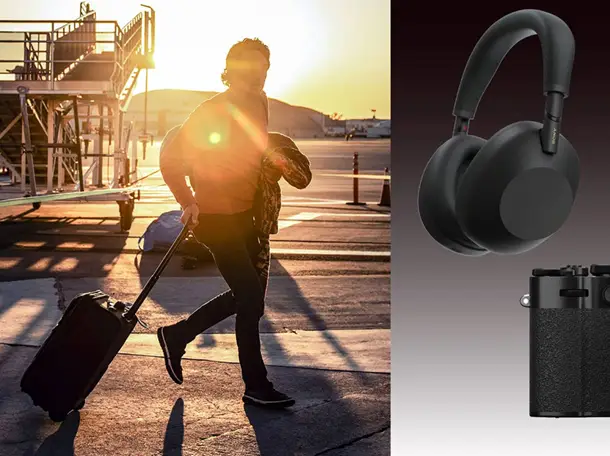
Sleep & Comfort Gadgets: Arrive Refreshed
Sleep quality while travelling directly affects your performance when you are there, especially across time zones. A small selection of low-cost items can make a real, measurable difference. Here are four worth adding to your kit.
1. Trtl Travel Pillow Plus:
The Trtl Travel Pillow Plus (updated 2026) is the choice for window-seat travellers. The internal spine structure will support the neck from the side in a posture that mimics the natural sleep position, not like traditional foam ring designs, which push the head forward and cause the familiar chin-to-chest slump. At 150g, it rolls up virtually flat and adds nothing of substance to carry-on weight. The only constraint is the same as before; it works best with a window or a wall surface to lean against.
2. Cabeau Evolution S3
The Cabeau Evolution S3 is designed for middle and aisle seats. Its memory foam contours to the neck, a rear strap clips to the headrest to stop it sliding forward, and the cover is removable and washable. It’s chunkier than the Trtl at 286g, but supports the head from any seat position.
3. Alaska Bear Natural Silk Sleep Mask
The Alaska Bear is the best value sleep mask. Genuine mulberry silk, a contoured nose bridge to block light without pressing on your eyes, and an adjustable strap that doesn’t pull hair. Nobody should be paying more than $15 for an airline’s throwaway alternative.
4. LectroFan Micro2
The LectroFan Micro2 is a white noise machine the size of a golf ball that clips onto a bag strap or sits on a bedside table. It has 10 fan sounds and 10 white noise variations, charges via USB-C, and lasts 16 hours on a single charge. Hotel ambient noise – air conditioning hum, corridor footsteps, and early deliveries – can disturb light sleepers even when they’re genuinely exhausted. It weighs 57 grams, costs nothing to carry, and makes a measurable difference in sleep quality on a long multi-night trip by providing a constant audio layer over those erratic sound spikes.
Quick-Reference Comparison Table: All Top Picks At A Glance
All products listed in this table have been personally tested on several trips in 2026. Nothing appears here based on press samples or brand relationships.
Category | Top Pick | Price | Budget Alternative | Best For |
Power bank | Anker 733 | ~$60 | Baseus Adaman 2 Pro (~$50) | Everyday/extended trips |
Wall charger | Anker Prime 100W GaN | ~$70 | Ugreen Nexode 65W (~$40) | Multi-device charging |
Connectivity | GL.iNet Beryl AX | ~$90 | Airalo eSIM (from $4.50) | Groups/solo |
Luggage tracker | Apple AirTag Gen 2 | ~$35 | Tile Pro 2026 (~$35) | iOS / cross-platform |
Headphones | Sony WH-1000XM6 | ~$380 | Soundcore Space Q45 (~$80) | Long-haul flights |
Action camera | GoPro Hero 13 | ~$400 | DJI Osmo Action 5 Pro (~$360) | Adventure/vlogging |
Travel pillow | Trtl Plus | ~$60 | Cabeau Evolution S3 (~$60) | Window / any seat |
Sleep mask | Alaska Bear Silk | ~$15 | — | All travellers |
Buying Tips: What To Look For Before You Purchase
Before buying, run through these four checks.
- IATA Rules For Battery Carry-On Compliance 2026: Power banks over 100Wh must go in carry-on, not checked luggage. Batteries larger than 160Wh are prohibited. The Baseus Adaman 2 Pro is 74Wh, which is within the limits, but you should check with your airline, as rules vary.
- Universal Voltage On The Labe: Any charger you use internationally should be rated at “100–240V, 50/60Hz.” A 110V-only device plugged into a 240V outlet will malfunction or fail in a dangerous way. All chargers in this guide are universally compatible.
- Warranty Coverage Across Borders: Major brands like Anker, Sony, Bose, Apple, GoPro, and DJI offer international warranties, though claims processes vary by region. Smaller brands typically only cover you in the country where you buy. Remember this when the price difference between brands gets smaller.
- Buying vs Renting: Pocket Wi-Fi routers can be rented at arrival terminals in Tokyo, Amsterdam, and most Southeast Asian airports for $5–10/day. For trips shorter than five days, rent, don’t buy. BorrowLenses and LensRentals also offer action cameras. Only buy if you travel regularly.
Conclusion:
The best travel gadgets in 2026 are not the ones with the longest list of features — they are the ones that solve real, repeatable problems without adding unnecessary weight or complexity. Most travellers will have enough power out of the Anker 733 and a 100W GaN charger. An Airalo eSIM or GL handles connectivity.iNet Beryl AXE. Checked luggage secured with an AirTag Gen 2 or Tile Pro. Long-haul flying is restful with Sony’s WH-1000XM6 or Soundcore’s Space Q45.
Your kit should be customised to your own travel pain points. Solo travellers need different things from families and adventure travellers. Start with the category that most disrupts your trips – usually power or connectivity – and work outward from there. The right gear will not save a bad trip, but it will save a good trip from falling apart.