
Roaming charges ruin trips. So does hunting for a local SIM card at 2 AM after a delayed flight. Yesim promises to solve both problems with one app-based eSIM.
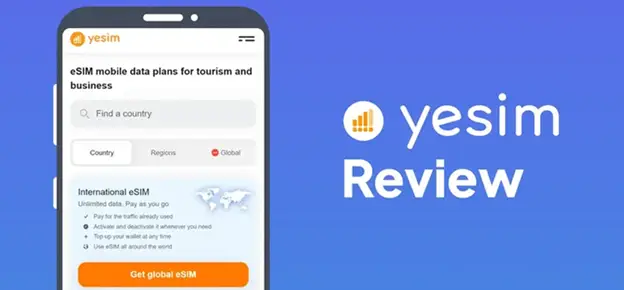
It is a data-only eSIM service based in Switzerland, with coverage in over 200 destinations worldwide. This yesim review is based on hands-on testing across setup, network speed, pricing, and support. We also compare Yesim with major rivals such as Airalo, Saily, and Holafly.
The goal is simple: this yesim review helps you to decide whether Yesim is worth your money before your next trip. Below you’ll find a full technical breakdown, real-world pricing examples and an honest list of pros and cons. If you travel often, this Yesim review should answer all your questions.

What Is Yesim?
Yesim is the headquarters of Genesis Group AG, a telecom company founded in 2019 in Zug, Switzerland. It’s designed for travelers, digital nomads, and business users. People who cross borders often enough that buying a new physical SIM in every country becomes more of a hassle than it’s worth.
The basic pitch is simple: one data-only eSIM profile, installed digitally via an app or QR code, that eliminates roaming fees and the plastic SIM shuffle. You don’t need a new plan every time you enter a new country. Yesim’s regional and global bundles cover multiple countries on one eSIM.
The One Caveat to Know
- The one caveat to keep in mind before you buy is that Yesim doesn’t offer native voice calling or SMS. All the plans are data-only, meaning phone calls and texts go through VoIP apps rather than a traditional phone line:
- Instead of a regular phone line, calls and texts are routed through apps like WhatsApp, Telegram or iMessage.
If you specifically need a number that can receive text messages or incoming calls the old-fashioned way, you’ll need more than just Yesim. You can either add Yesim’s separate virtual number or choose a different service altogether.
How Yesim Works: Setup & Activation
Yesim is supposed to get up and running quickly, and for the most part, it does. First, you get the app (or go to the website), make an account with an Apple ID, Google account, or just a plain email address, with no long verification process between you and buying a plan.
From there, you can browse by country, region, or global bundle. Checkout supports cards, Apple Pay, Google Pay, PayPal, and even cryptocurrency through Binance Pay, an unusual option among eSIM providers. Installation is either directly inside the app or by scanning a QR code sent by email, the same basic flow used by most competing services.
One thing that makes Yesim unique is its activation window. Yesim doesn’t activate the eSIM when you buy it. You can download the profile up to 12 months in advance and activate the actual data plan only when you land. That’s actually useful for people who book trips early and don’t want a data clock ticking down before they’ve even left home.
Before You Install
- Dial *#06# on your device. If an EID number appears alongside your IMEI, your phone supports eSIM.
- Supported devices generally include iPhone XR/XS and later, Google Pixel 3 and later, and Samsung Galaxy S20-series and later.
- Ensure a stable Wi-Fi connection during setup. The QR code is for one-time use. If you have a weak connection while scanning, the profile will not be installed. The code will be invalidated, and you will need to request a new code from support.
In hands-on testing, the time between QR scan and active data connection was around three to five minutes on supported devices. These are fast enough that you can realistically do it in an airport lounge before boarding. The biggest problem isn’t the install. The next step: the eSIM will install fine but will show no data when it arrives.
The fix, in almost all cases, is to manually turn on Data Roaming on the Yesim line, as the phone won’t do so automatically. Most lingering connection problems are resolved by turning airplane mode on and off again, which triggers a network rescan.
Coverage & Network Quality
While conducting the Yesim review, I found that, it covers 200+ destinations and works with 800+ mobile operators globally, so it looks pretty comprehensive on paper. Independent testing in practice suggests that the actual number of consistently active countries is closer to 170-182. These places are just behind Airalo’s roughly 210 destinations, not out in front of the pack. For the average traveler who sticks to popular routes, that gap rarely matters. It’s worth knowing whether your trip includes less-traveled corners of the world.
Plan Tiers by Geography
Plans are organized into three tiers:
- Local plans cover a single country and suit short, focused trips.
- Regional plans bundle multiple countries into a single eSIM. Yesim currently runs ten of these: Europe (31 countries), Asia-Pacific (15), North America (3), South America (11), the Caribbean (14), the Middle East (8), Africa (15), Scandinavia (6), Central Asia (6), and Southeast Asia (8).
- Global plans sit above those, with one option covering some 147 countries and a wider bundle stretching toward 170, depending on which global tier you choose at checkout.
One quirk to note about the names is that plans listed by city name, such as “Tokyo” or “Paris,” actually provide nationwide coverage rather than a city-limited radius. That trips up first-time buyers who assume otherwise.
Network Performance:
Expect good network performance in major cities and along popular routes. Where available, including the US and Western Europe, you will get 5G, with 4G as a reliable fallback elsewhere. In the US, Yesim is an MVNO that connects to both T-Mobile and AT&T simultaneously.
For this reason, the device can automatically pick the stronger network in a given location, a real advantage on road trips through areas where one carrier has dead zones. Outside the major cities, performance tends to depend on the local partner network that is strongest in the area. As a result, rural coverage is generally more variable than urban coverage.
Where Coverage Falls Short
That variability is reflected in scattered but real complaints from users tied to particular countries:
- Patchy 3G-only service across several networks in Algeria despite a paid weekly plan.
- Recurring multi-hour outages reported in Mauritius.
- At least one traveler in Nepal gave up on the eSIM entirely and bought a local SIM instead.
These aren’t the majority’s experience; most reviews describe reliable service on standard travel routes. They’re a reminder that coverage quality isn’t perfectly uniform across all 200+ destinations.
Plans & Pricing Breakdown
Standard vs. Unlimited vs. Pay & Fly
During Yesim review, it is found that pricing is more flexible than most competitors’, which is either a strength or a source of confusion, depending on how much you like to comparison-shop.
- Standard plans have fixed data limits ranging from 1GB to 20GB, depending on the validity period. And if you run out early, you can’t top up; you have to buy a whole new plan, which can be more expensive than a slightly bigger plan would have been up front.
- Unlimited plans flip the model on its head and charge a flat daily rate, rather than a per-gigabyte rate, but they are subject to a Fair Usage Policy (not always clearly spelt out). In one case we looked at, the “unlimited” plan gave you 50GB at full speed over 30 days. After that, it dropped you to a reduced 5GB at a throttled speed, which is fine for most needs but not truly unlimited as most people would expect.
- Pay & Fly is somewhere in between those two, an easy pay-as-you-go option with 170+ destinations on one eSIM. You only pay for the data you actually use; there is no fixed expiry, and the minimum top-up is around $10. It is often the most economical setup for travelers with unpredictable itineraries, multiple countries, and unclear trip length, since you never pay for data you don’t use.
Sample Pricing (2026)
Destination
| Plan Type | Approximate Price |
United States | Unlimited (flat daily rate) | ~$3.60/day |
United States | Pay & Fly (per GB) | ~$2.08/GB |
United Kingdom | Pay & Fly (per GB) | ~$1.48/GB |
France | Pay & Fly (starting rate) | From ~$0.54 |
Turkey | Standard (per GB, weekly) | Under $2/GB |
Standard (fixed data) | Mid-range vs. regional average | |
Global bundle | Regional/Global fixed plan | Varies by country count covered |
Prices shift with promotions and currency, so it’s worth double-checking the live app before buying rather than treating the table above as fixed.
The Y Coin System
Another quirk that adds friction to the buying process is Yesim’s internal currency, Y Coins. Instead of paying for a plan directly, you first convert real money into Y Coins. Then, you use those coins at checkout, with 100 Y Coins worth about €0.81 or $1.00 depending on your payment currency. It’s a small extra step, but some reviewers cite it as an unnecessary complication for something that should be a one-click buy, especially when compared to Airalo’s direct card checkout.
Standout Features Beyond Basic Data
Built-In VPN
Yesim is not a basic functional data plan; it comes with a few extras packaged with the app. The big draw here is the built-in VPN, which keeps your connection secure over public Wi-Fi as you travel. It protects your data in airports, hotel lobbies, and cafés, where security is often an afterthought. The catch: it only works on iOS right now. Android users get the rest of Yesim’s feature set, but not this particular layer of security, and the marketing doesn’t always make that distinction obvious before you buy.
Virtual Phone Numbers
Another notable add-on is virtual phone numbers, sold separately from data plans rather than bundled. They’re mainly for SMS verification and app registration – i.e., registering WhatsApp, getting a one-time banking code, or signing up for a service that requires a live number. They’re a purchase for a specific use case, not a replacement for a full local phone line with ongoing call and text capability.
Tethering & hotspot
Most plans officially allow tethering and hotspot usage at no additional cost. Shared data is deducted from your existing allowance rather than billed separately. That said, results aren’t universal. At least one independent speed test reported a hotspot failing during testing, so it’s worth confirming it works on your specific device and destination rather than assuming it will.
Performance & Support Experience
In most of the regions we tested, everyday use, browsing, maps and messaging apps are smooth. That is especially true in urban areas and on main traffic routes. Hotspot performance is a little more unpredictable, with occasional slowdowns in extremely dense areas, such as Times Square, Downtown Los Angeles, and the Las Vegas Strip, on a busy weekend. That’s more a function of local network congestion than anything specific to Yesim.
The bigger performance issue occurs on unlimited plans after the fair usage threshold is exceeded. You could be throttled down to as low as 512 kbps. That’s fine for messaging and email, but frustrating for anything involving video.
Platform Differences & Support Responsiveness
Besides the above-mentioned VPN gap, platform differences between Android and iOS are minimal. Installation, plan management, hotspot use and virtual numbers all function similarly on both operating systems. In Yesim review, it is also noticed that it consistently loses points on across independent reviews is support responsiveness. Live chat is available from around 8:00 AM to 1:00 AM (GMT+2). When necessary, an automated bot asks questions and escalates to a human.
In several reviews, the common complaint is the wait, with average response times of about five hours. That’s sluggish compared to competitors that offer near-instant chat support. The good thing is that when a human does answer, the answers are usually thorough and actually solve the problem rather than deflect it.
Yesim Review vs. Competitors: Comparison Table
Coverage and pricing only tell part of the story. How Yesim stacks up against the other big players in the eSIM world matters just as much when deciding whether it’s the right fit for a particular trip.
Factor | Yesim | Airalo | Saily | Holafly |
Coverage | 170–200+ destinations | ~210 destinations | Wide, budget-focused | Fewer countries, unlimited-only focus |
Price per GB | Mid-range, varies by region | Generally, it is cheapest for small plans | Very competitive | Higher, but often includes true unlimited |
Small plans (1–2GB) | Not typically offered | Yes, widely available | Yes | No, unlimited only |
Security extras | Free VPN (iOS only) | None built-in | Virtual location changer, ad blocker, NordVPN suite (subscription) | None built-in |
Virtual numbers | Yes (separate purchase) | No | No | No |
Support quality | Slower response (~5 hrs avg) | Generally responsive | Strong reputation for support | Standard support |
Yesim vs Airalo
Between Airalo and the others, the choice comes down to your trip type. Airalo clearly wins on price for short, single-country trips and small data plans, as Yesim doesn’t really compete in the 1–2 GB range. When it comes to multi-country travel, Yesim leads the pack with its flexible plan structures, virtual numbers, and built-in VPN. Airalo doesn’t offer these additional features.
Yesim vs Saily
The comparison is closer against Saily, which is easier to use, generally cheaper, and bundles a more complete security suite through its NordVPN-adjacent extras. However, Yesim counters with virtual numbers and crypto payment support that Saily completely skips.
Yesim vs Holafly
If you want to do a lot of video streaming, then the choice is between Holafly and Yesim. Holafly is better for travelers wanting unlimited data with no daily throttling, particularly on long-haul trips. Yesim is usually the more affordable option for shorter or multi-country trips, where Holafly’s premium pricing can quickly become expensive.

Pros, Cons & Who It’s For
Pros:
Yesim’s biggest strengths are its flexibility and the extras that most competitors don’t bother building at all:
- It is a true data-only eSIM with no roaming fees that activates within minutes through the app or a QR code. Broad coverage with 800+ partner operators.
- Travelers have more ways to match a plan to their actual trip pattern than most single-format competitors. Thanks to the three-tier plan structure: Standard, Unlimited, and Pay & Fly.
- And you won’t find the built-in VPN and the purchasable virtual numbers bundled together anywhere else in this space.
- It has a 12-month activation window; you can buy early without losing any time on an active data clock.
Cons:
The drawbacks are real, though, and worth weighing before you commit:
- There is no native voice or SMS, so VoIP apps are a must, not an option.
- Fair usage limits for unlimited plans are not always clearly advertised, and throttled speeds can be restrictive for anyone who streams video regularly.
- The VPN is only available on iOS, so Android users do not have that layer of security at all. The Y Coins system is an extra purchase step that most competitors do not use.
- Support response times are about 5 hours (which is slow by industry standards), and coverage quality varies by destination (per ongoing user reports from certain countries).
In short, Yesim is ideal for frequent multi-country travelers, digital nomads and business users who want flexibility, virtual numbers for verification or VPN protection on top of their connection. It’s better for someone doing a single short trip. It only needs 1–2 GB of data, whereas Airalo is the cheaper option. For anyone planning heavy video streaming and needing guaranteed unlimited speeds with no throttling, Holafly is a better fit.
Conclusion:
Yesim review earns a solid place among the top travel eSIM providers in 2026, especially for the multi-country traveler who wants more than just raw data. This Yesim review is based on its real staying power. It offers one flexible eSIM for 200+ destinations, a built-in VPN, purchasable virtual numbers, and a pay-as-you-go option that most competitors don’t offer.
It’s not the cheapest option for a quick weekend trip. The Y Coins system and slower support response times are also legitimate drawbacks to consider before you buy.
However, for digital nomads, business travelers, and anyone crossing multiple borders on one trip, Yesim’s flexibility often outweighs those downsides. If that matches your travel style, install the eSIM before your trip. Turn it on when you land, and skip the airport SIM scramble entirely.
Frequently Asked Questions:
Is Yesim legit and safe to use?
Yes – Yesim is operated by a registered Swiss telecom company with a multi-year track record and millions of users. Some review platforms have flagged and removed inauthentic reviews, so it’s worth reading a range of sources rather than relying on a single rating.
Does Yesim work with WhatsApp calls and other VoIP apps?
Yes. Yesim is a data-only eSIM and does not support native calls or SMS. To communicate, use VoIP apps like WhatsApp, Telegram, or iMessage. They work the same way as they do over any other data connection.
How does the unlimited data Fair Usage Policy work?
Unlimited plans provide high-speed data up to a specific limit, usually about 50GB in 30 days. After that, speeds are throttled rather than data being cut off entirely. The exact thresholds vary by plan and are not always detailed on the website.
Is the free VPN available on Android?
No. The rest of the app is the same on Android and iOS, but the built-in VPN only works on iOS for now. So Android users are missing out on that particular security feature.
What happens when I run out of data?
With Standard plans, you can’t top up; you’ll have to buy yourself a whole new plan. With Pay & Fly, you top up your balance and keep using the same eSIM without reinstalling anything.
Does Yesim come with a phone number?
All plans are data-only, not by default. You can purchase virtual phone numbers for SMS verification or app signups, but they are sold separately from your data plan.
Is Yesim cheaper than a local SIM?
Depends on where you’re going. In many countries, a local SIM bought on arrival works out cheaper per gigabyte. Yesim saves time, eliminates the language barrier, and eliminates the hassle of finding a local shop, a trade-off many travelers find worth the extra cost.